

Naveed Qureshi always knew his job was important, but as a telecoms engineer working in East London, it didn’t always feel that way. He spent each week patrolling his patch of the city, riding out in his van to maintain the miles upon miles of copper wire and fiber optic cable that kept the capital online. Schools, hospitals, and businesses all relied on this invisible network, and with the pandemic forcing people to work from home, there was more strain on the system than ever before. His job felt undeniably essential. He just wished it wasn’t dangerous, too.
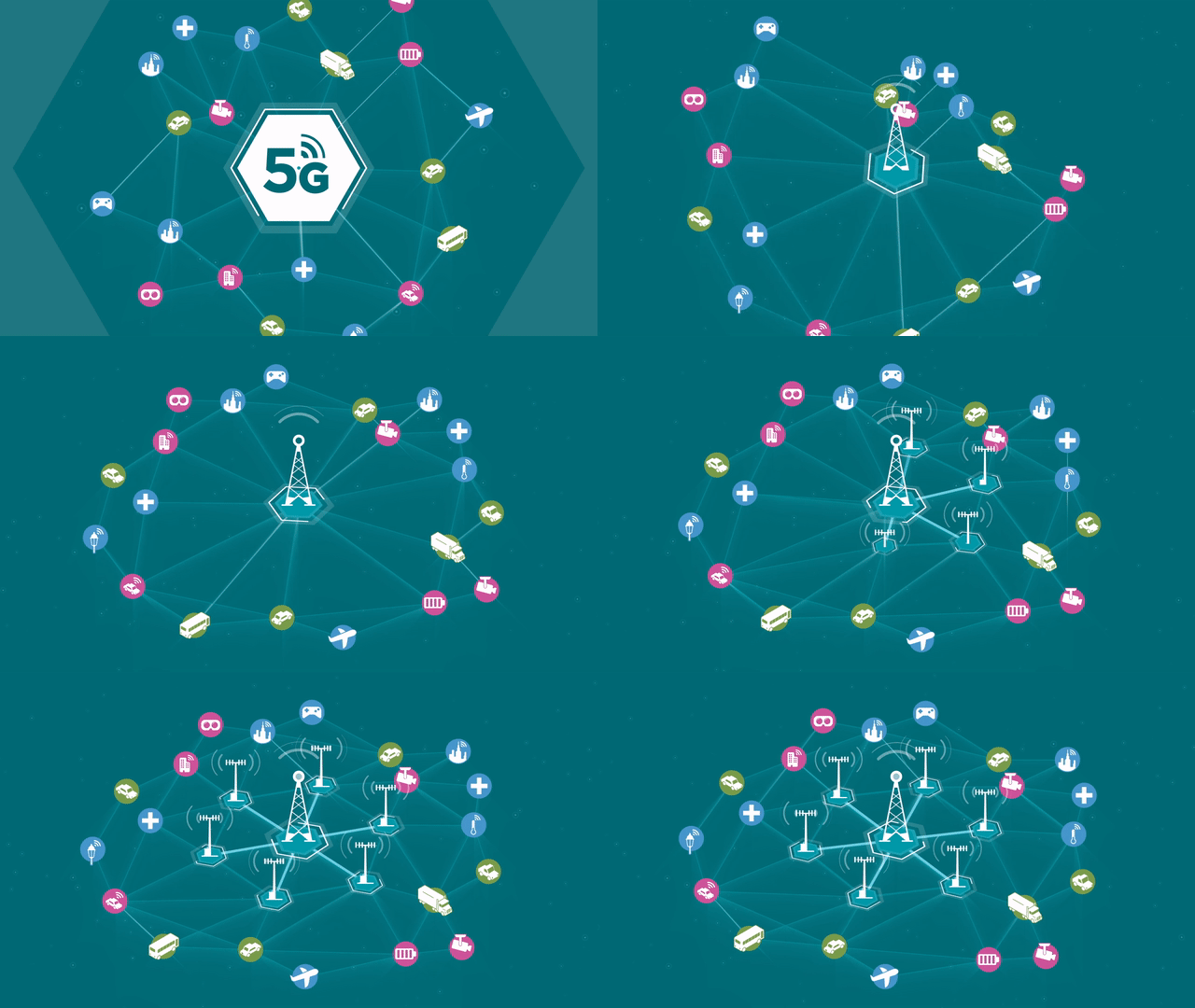
Since the UK entered lockdown in March, engineers like Qureshi had unwillingly found themselves on the front line of a strange global crusade. Conspiracy theorists had linked the spread of the novel coronavirus to the installation of new 5G mobile networks, with some claiming the cellular network weakened the immune system and allowed the virus to thrive, while others said 5G masts were broadcasting the virus through the ether (all “crackpot” claims, to quote the UK government). The thing these theories have in common is that they give people someone to blame. And though some of that paranoia comes from a reasonable mistrust of large corporations and institutions, the end target was always workers like Qureshi, out on the street in high-visibility vests, just trying to do their job.
Most incidents could be classified as harassment. Shouted insults, death threats, and the like. But others were more violent. Razor blades and needles had been hidden behind posters on telephone poles, waiting to catch unwitting hands. Attackers had set cellphone masts on fire and shared the videos on social media to the applause of fellow conspiracists. According to figures shared with The Verge by industry body Mobile UK, there were more than 200 incidents of abuse against telecoms engineers since March 30th and more than 90 arson attacks against mobile infrastructure.
All this was in the back of Qureshi’s mind when, on a Tuesday morning in April, a woman approached the side of his van, parked near a high street in a northeastern district of the capital called Walthamstow, and gestured for him to roll down the window.
“What are you doing?” she asked, bluntly.
Qureshi, a quiet man in his forties with soft eyes and a closely cropped haircut, explained that he needed to climb the telephone mast behind him to fix a fault, but couldn’t say more because of customer privacy.
“Oh, okay…” said the woman, “but you’re lying.”
Qureshi nodded and smiled, trying to keep things polite, but in his head alarms were going off as he thought to himself: Please don’t be 5G. Please don’t be 5G. Please don’t be 5G.
The woman started talking about radiation and microwaves, about the harmful effects of electromagnetic signals on the body, how signals from 5G — there it was — broke down blood cells like acid. She had plenty of stats to back up her argument, much of which Qureshi recognized from the copypasta conspiracy messages passed around social media. She boasted that, unlike him, she’d actually done her reading on the subject. Even though Qureshi had been professionally trained in this work, he knew it was fruitless to argue. Any point he brought up would be shot down by the woman’s self-fulfilling rationalization that Qureshi was part of a global conspiracy.
Normally, Qureshi enjoys the public’s curiosity about his job, particularly children. When he’s working on a cabinet — anonymous green metal boxes, seen on most UK streets, that provide street-level access to the nation’s network — people always ask questions. Sometimes they’re curious enough to stop and watch over Qureshi’s shoulder as he works.
In each cabinet there are thousands and thousands of copper wires, encased in different colored plastic. Each one connects the underground telephone and internet lines to individual properties, and maintaining these junctions is a big part of an engineer’s job. Opening a new cabinet is a lottery. Sometimes the wires inside are neat and tidy: a pleasure to trim and replace as necessary. Other times they resemble a desk drawer crammed full of old computer cables: a tangled and unruly mess which takes hours to bring to order.
Each time Qureshi opens a cabinet, people ask him the same question: “How do you know what’s going on in there?” And every time, he gives the same answer: “Practice.”
In Walthamstow, though, there wasn’t any friendly banter. As the woman ranted, Qureshi began to worry about the stories he’d heard from fellow engineers. There have been threats aplenty, kicks and punches thrown at vans. One engineer was even spat at and had to self-isolate after developing symptoms consistent with COVID-19. How far would this woman take things?
After vocalizing her theories, she seemed content in having passed on the message. Eventually, she got tired or bored and moved on down the road, and Qureshi resumed his work, counting himself lucky that it hadn’t escalated further.
Like most other engineers in the capital, Qureshi works for Openreach, a subsidiary of BT Group, the country’s largest internet supplier and a former nationalized monopoly. Each morning, he logs onto the Openreach app to receive a list of jobs in his designated area. Sometimes it’ll mean climbing a telephone pole, other times he’ll be lost in the puzzle of a malfunctioning cabinet. The work is varied, he says, and all the better for it.
But hours later in Leyton, Qureshi was coming to the end of his cabinet job when the woman reappeared. This time, he says, she seemed more agitated and approached him with a friend.
She raised her voice almost immediately: “‘You’re killing people. You know what you’re doing. How could you do this?’”
He tried to follow company training and not engage with the accusations, but the woman was getting more and more upset. 5G was causing the symptoms of COVID-19, she told him, and he was secretly installing the high-speed network under instructions from the local council.
The woman was beginning to drag in bystanders at this point. She corralled a group of men who were drinking in the street and pointed Qureshi out to them. “He’s the one who’s killing everyone,” she told them. “He’s spreading all this virus.”
The crowd was split. Some didn’t seem to care, while others were on the woman’s side, or at least bored enough to go along with it. They began to edge closer, cans of beer in hand. Qureshi could see them looking over at him, and he heard their voices drift down the street toward him. “Murder,” “killer,” “watch out.” The woman was now screaming and flagging down cars in the street. More people were stopping, trying to work out what was going on.
At this point, thought Qureshi, it was time to leave. He called his manager, who told him to pack up his kit and get out of there quickly. (London’s Metropolitan Police confirmed to The Verge that the alleged incident had been reported to them, and that while inquiries were currently continuing, no arrests had been made.)
Looking back at the ordeal, Qureshi says the most aggravating thing wasn’t the intimidation itself or the disruption to his work. It was the sheer lack of understanding from the crowd. He was working on their street to fix their internet, to keep their phones and laptops working during a time of crisis. Didn’t they know that? As he told them: “It could be your service I’m working on.”
But the most galling evidence that Qureshi’s accusers didn’t know what they were talking about still irritates him: he wasn’t even working on 5G. In fact, he’s never worked on 5G. His employer, Openreach, doesn’t directly maintain mobile networks at all: they mostly repair home internet and telephone lines. It didn’t matter. He, like the scores of other engineers who have been abused by conspiracy theorists, was targeted all the same. 5G and the novel coronavirus may be invisible threats, but workers like Qureshi offer tangible targets.
EasterEaster weekend was a busy one for the UK conspiracy theorists. While some people were adapting to a bank holiday stuck at home and Sunday church services over Zoom, no fewer than 20 phone masts were targeted in the UK in suspected arson attacks.
Mobile operators blamed the attacks on the 5G conspiracy and noted that because of the slow rollout of the high-speed network, most of the infrastructure hit was actually providing 3G and 4G coverage, not even the newer 5G. Up and down the country, firefighters rushed to put out blazes, and telecoms engineers worked overtime to restore lost service. Vodafone UK, one of the mobile operators affected by the attacks, noted that the equipment targeted included a mast providing mobile connectivity to a temporary hospital built for COVID-19 patients.
“It’s heart-rending enough that families cannot be there at the bedside of loved ones who are critically ill,” wrote Vodafone UK CEO Nick Jeffery on LinkedIn. “It’s even more upsetting that even the small solace of a phone or video call may now be denied them because of the selfish actions of a few deluded conspiracy theorists.”
Although Mobile UK tells The Verge that attacks like these seem to be slowing, they were initially coordinated on social media. In a now-deleted Facebook group called “5G TOWER FIRE COMP,” users shared maps of potential targets, commenting “you know what to do” underneath them. One post from an admin of the group compiled a tally of arson incidents by city with the title “5G Tower Fire Table Championships sponsored by EE & VODAPHONE” and the call to arms: “THERE IS A LEAGUE LET’S GOOOOOOOO!!!!” And when a 70-foot tower was set ablaze in Birmingham, a video of the incident was dropped in the group with the text “Birmingham 1- 0 West Bromwich Albion. ⚽️ An excellent opener from Birmingham, they’re on fire at the moment,” and the hashtag #5GisGenocide. (The tower was providing 4G service.)
The UK certainly hasn’t been alone in suffering arson attacks, with similar incidents reported in the Netherlands, Ireland, Belgium, Italy, Cyprus, and Sweden. It does, however, seem to have seen more than any other nations, perhaps as a result of incubating a particular viral strain of the conspiracy.
Adherents in the UK have spread their messages not just via social media but through local government, celebrity endorsements, and even mainstream news. The UK’s TV regulator, Ofcom, for example, had to rebuke the presenter of a popular morning news show for “undermining viewers’ trust in advice from public authorities and scientific evidence” in a segment covering the arson attacks after he said it was easy to dismiss links between 5G and the novel coronavirus “because it suits the state narrative.”
Part of the reason for the speedy embrace of the conspiracy is that it builds upon existing networks of misinformation, says Grace Rahman, online fact-checking lead for UK charity Full Fact. Bogus claims about the health dangers associated with cellphone signals go back years, she says, and have been linked to the 5G rollout pretty much since the first equipment began to be installed.
“We first checked something to do with 5G half way through 2019,” Rahman tells The Verge, referencing a viral image that supposedly shows a man in a hazmat suit cleaning a 5G mast. “Their interpretation was that he’s wearing a hazmat suit to protect himself against 5G. In actual fact he was almost certainly cleaning bird poo.”
The link between 5G and the novel coronavirus began to appear sometime in mid-January, when people began to connect Wuhan as the original source of the outbreak and an early testing site for 5G. (Rahman notes that other big cities had similar trials without similar outbreaks, while Iran, which also had an early outbreak of COVID-19, doesn’t have 5G networks at all.)
Once the UK entered lockdown in March, though, the theories began to spread faster than ever on social media.
“As the lockdown measures became a lot more serious, it did feel like the conspiracy theories were also becoming more extreme with it,” says Rahman.
Engineers who spoke to The Verge spoke about incidents of abuse related to the conspiracy theory reported a similar change in the mood on the street. People are cooped up, they said, frustrated about the new restrictions, stuck at home, and looking for an explanation that made sense.
“They just want to blame someone,” says Qureshi. “They see these deaths on the news, every day there’s big spikes, a thousand deaths. Possibly their loved ones could have been one of those stats. And so I can understand that. But to point the finger at just anyone… Who’ll be the next target?”
Teasing apart the precise beliefs of any 5G conspiracy theorist is as difficult as sorting the cables in a haphazard telecoms cabinet, but there are some shared items of faith among adherents. Pretty much all of those involved suggest that the dangers of 5G have been underestimated while the threat of the pandemic has been overexaggerated.
These beliefs succeed partly because they fit into an established corpus of conspiracy and pseudoscience, says Rahman. Fears about 5G dovetail neatly with both the anti-vax movement and libertarian fears about a New World Order. And in both the US and the UK, this energy has been fostered by more mainstream political figures who want to end the lockdown not necessarily because they believe the pandemic is fake, but because of worry about economic costs or perceived infringement of civil liberties.
Rahman says the situation has not been helped by the fact that, in the early weeks at least, finding reliable information about COVID-19 was difficult. Even the name “coronavirus” created misinformation, as it refers to a whole group of existing viruses with different histories and characteristics, says Rahman. “That was a bit of a nightmare, because so much of what we were fact-checking was based on scientific papers about other coronaviruses.”
As a report from the World Health Organization noted in February, the pandemic has been accompanied by a “massive infodemic.” This takes the form of an “over-abundance of information — some accurate and some not — that makes it hard for people to find trustworthy sources and reliable guidance when they need it.” One historian of science compared the situation to the 17th century, noting that “we are living in a moment of ground-zero empiricism, in which almost everything is up for grabs” — including, it seems, non-scientific explanations. It’s an environment of unknowns that breeds conspiracy, and an environment of conspiracy that inspires violence. Source : Link
Since the UK entered lockdown in March, engineers like Qureshi had unwillingly found themselves on the front line of a strange global crusade. Conspiracy theorists had linked the spread of the novel coronavirus to the installation of new 5G mobile networks, with some claiming the cellular network weakened the immune system and allowed the virus to thrive, while others said 5G masts were broadcasting the virus through the ether (all “crackpot” claims, to quote the UK government). The thing these theories have in common is that they give people someone to blame. And though some of that paranoia comes from a reasonable mistrust of large corporations and institutions, the end target was always workers like Qureshi, out on the street in high-visibility vests, just trying to do their job.
Most incidents could be classified as harassment. Shouted insults, death threats, and the like. But others were more violent. Razor blades and needles had been hidden behind posters on telephone poles, waiting to catch unwitting hands. Attackers had set cellphone masts on fire and shared the videos on social media to the applause of fellow conspiracists. According to figures shared with The Verge by industry body Mobile UK, there were more than 200 incidents of abuse against telecoms engineers since March 30th and more than 90 arson attacks against mobile infrastructure.
All this was in the back of Qureshi’s mind when, on a Tuesday morning in April, a woman approached the side of his van, parked near a high street in a northeastern district of the capital called Walthamstow, and gestured for him to roll down the window.
“What are you doing?” she asked, bluntly.
Qureshi, a quiet man in his forties with soft eyes and a closely cropped haircut, explained that he needed to climb the telephone mast behind him to fix a fault, but couldn’t say more because of customer privacy.
“Oh, okay…” said the woman, “but you’re lying.”
Qureshi nodded and smiled, trying to keep things polite, but in his head alarms were going off as he thought to himself: Please don’t be 5G. Please don’t be 5G. Please don’t be 5G.
The woman started talking about radiation and microwaves, about the harmful effects of electromagnetic signals on the body, how signals from 5G — there it was — broke down blood cells like acid. She had plenty of stats to back up her argument, much of which Qureshi recognized from the copypasta conspiracy messages passed around social media. She boasted that, unlike him, she’d actually done her reading on the subject. Even though Qureshi had been professionally trained in this work, he knew it was fruitless to argue. Any point he brought up would be shot down by the woman’s self-fulfilling rationalization that Qureshi was part of a global conspiracy.
Normally, Qureshi enjoys the public’s curiosity about his job, particularly children. When he’s working on a cabinet — anonymous green metal boxes, seen on most UK streets, that provide street-level access to the nation’s network — people always ask questions. Sometimes they’re curious enough to stop and watch over Qureshi’s shoulder as he works.
In each cabinet there are thousands and thousands of copper wires, encased in different colored plastic. Each one connects the underground telephone and internet lines to individual properties, and maintaining these junctions is a big part of an engineer’s job. Opening a new cabinet is a lottery. Sometimes the wires inside are neat and tidy: a pleasure to trim and replace as necessary. Other times they resemble a desk drawer crammed full of old computer cables: a tangled and unruly mess which takes hours to bring to order.
Each time Qureshi opens a cabinet, people ask him the same question: “How do you know what’s going on in there?” And every time, he gives the same answer: “Practice.”
In Walthamstow, though, there wasn’t any friendly banter. As the woman ranted, Qureshi began to worry about the stories he’d heard from fellow engineers. There have been threats aplenty, kicks and punches thrown at vans. One engineer was even spat at and had to self-isolate after developing symptoms consistent with COVID-19. How far would this woman take things?
After vocalizing her theories, she seemed content in having passed on the message. Eventually, she got tired or bored and moved on down the road, and Qureshi resumed his work, counting himself lucky that it hadn’t escalated further.
Like most other engineers in the capital, Qureshi works for Openreach, a subsidiary of BT Group, the country’s largest internet supplier and a former nationalized monopoly. Each morning, he logs onto the Openreach app to receive a list of jobs in his designated area. Sometimes it’ll mean climbing a telephone pole, other times he’ll be lost in the puzzle of a malfunctioning cabinet. The work is varied, he says, and all the better for it.
But hours later in Leyton, Qureshi was coming to the end of his cabinet job when the woman reappeared. This time, he says, she seemed more agitated and approached him with a friend.
She raised her voice almost immediately: “‘You’re killing people. You know what you’re doing. How could you do this?’”
He tried to follow company training and not engage with the accusations, but the woman was getting more and more upset. 5G was causing the symptoms of COVID-19, she told him, and he was secretly installing the high-speed network under instructions from the local council.
The woman was beginning to drag in bystanders at this point. She corralled a group of men who were drinking in the street and pointed Qureshi out to them. “He’s the one who’s killing everyone,” she told them. “He’s spreading all this virus.”
The crowd was split. Some didn’t seem to care, while others were on the woman’s side, or at least bored enough to go along with it. They began to edge closer, cans of beer in hand. Qureshi could see them looking over at him, and he heard their voices drift down the street toward him. “Murder,” “killer,” “watch out.” The woman was now screaming and flagging down cars in the street. More people were stopping, trying to work out what was going on.
At this point, thought Qureshi, it was time to leave. He called his manager, who told him to pack up his kit and get out of there quickly. (London’s Metropolitan Police confirmed to The Verge that the alleged incident had been reported to them, and that while inquiries were currently continuing, no arrests had been made.)
Looking back at the ordeal, Qureshi says the most aggravating thing wasn’t the intimidation itself or the disruption to his work. It was the sheer lack of understanding from the crowd. He was working on their street to fix their internet, to keep their phones and laptops working during a time of crisis. Didn’t they know that? As he told them: “It could be your service I’m working on.”
But the most galling evidence that Qureshi’s accusers didn’t know what they were talking about still irritates him: he wasn’t even working on 5G. In fact, he’s never worked on 5G. His employer, Openreach, doesn’t directly maintain mobile networks at all: they mostly repair home internet and telephone lines. It didn’t matter. He, like the scores of other engineers who have been abused by conspiracy theorists, was targeted all the same. 5G and the novel coronavirus may be invisible threats, but workers like Qureshi offer tangible targets.
EasterEaster weekend was a busy one for the UK conspiracy theorists. While some people were adapting to a bank holiday stuck at home and Sunday church services over Zoom, no fewer than 20 phone masts were targeted in the UK in suspected arson attacks.
Mobile operators blamed the attacks on the 5G conspiracy and noted that because of the slow rollout of the high-speed network, most of the infrastructure hit was actually providing 3G and 4G coverage, not even the newer 5G. Up and down the country, firefighters rushed to put out blazes, and telecoms engineers worked overtime to restore lost service. Vodafone UK, one of the mobile operators affected by the attacks, noted that the equipment targeted included a mast providing mobile connectivity to a temporary hospital built for COVID-19 patients.
“It’s heart-rending enough that families cannot be there at the bedside of loved ones who are critically ill,” wrote Vodafone UK CEO Nick Jeffery on LinkedIn. “It’s even more upsetting that even the small solace of a phone or video call may now be denied them because of the selfish actions of a few deluded conspiracy theorists.”
Although Mobile UK tells The Verge that attacks like these seem to be slowing, they were initially coordinated on social media. In a now-deleted Facebook group called “5G TOWER FIRE COMP,” users shared maps of potential targets, commenting “you know what to do” underneath them. One post from an admin of the group compiled a tally of arson incidents by city with the title “5G Tower Fire Table Championships sponsored by EE & VODAPHONE” and the call to arms: “THERE IS A LEAGUE LET’S GOOOOOOOO!!!!” And when a 70-foot tower was set ablaze in Birmingham, a video of the incident was dropped in the group with the text “Birmingham 1- 0 West Bromwich Albion. ⚽️ An excellent opener from Birmingham, they’re on fire at the moment,” and the hashtag #5GisGenocide. (The tower was providing 4G service.)
The UK certainly hasn’t been alone in suffering arson attacks, with similar incidents reported in the Netherlands, Ireland, Belgium, Italy, Cyprus, and Sweden. It does, however, seem to have seen more than any other nations, perhaps as a result of incubating a particular viral strain of the conspiracy.
Adherents in the UK have spread their messages not just via social media but through local government, celebrity endorsements, and even mainstream news. The UK’s TV regulator, Ofcom, for example, had to rebuke the presenter of a popular morning news show for “undermining viewers’ trust in advice from public authorities and scientific evidence” in a segment covering the arson attacks after he said it was easy to dismiss links between 5G and the novel coronavirus “because it suits the state narrative.”
Part of the reason for the speedy embrace of the conspiracy is that it builds upon existing networks of misinformation, says Grace Rahman, online fact-checking lead for UK charity Full Fact. Bogus claims about the health dangers associated with cellphone signals go back years, she says, and have been linked to the 5G rollout pretty much since the first equipment began to be installed.
“We first checked something to do with 5G half way through 2019,” Rahman tells The Verge, referencing a viral image that supposedly shows a man in a hazmat suit cleaning a 5G mast. “Their interpretation was that he’s wearing a hazmat suit to protect himself against 5G. In actual fact he was almost certainly cleaning bird poo.”
The link between 5G and the novel coronavirus began to appear sometime in mid-January, when people began to connect Wuhan as the original source of the outbreak and an early testing site for 5G. (Rahman notes that other big cities had similar trials without similar outbreaks, while Iran, which also had an early outbreak of COVID-19, doesn’t have 5G networks at all.)
Once the UK entered lockdown in March, though, the theories began to spread faster than ever on social media.
“As the lockdown measures became a lot more serious, it did feel like the conspiracy theories were also becoming more extreme with it,” says Rahman.
Engineers who spoke to The Verge spoke about incidents of abuse related to the conspiracy theory reported a similar change in the mood on the street. People are cooped up, they said, frustrated about the new restrictions, stuck at home, and looking for an explanation that made sense.
“They just want to blame someone,” says Qureshi. “They see these deaths on the news, every day there’s big spikes, a thousand deaths. Possibly their loved ones could have been one of those stats. And so I can understand that. But to point the finger at just anyone… Who’ll be the next target?”
Teasing apart the precise beliefs of any 5G conspiracy theorist is as difficult as sorting the cables in a haphazard telecoms cabinet, but there are some shared items of faith among adherents. Pretty much all of those involved suggest that the dangers of 5G have been underestimated while the threat of the pandemic has been overexaggerated.
These beliefs succeed partly because they fit into an established corpus of conspiracy and pseudoscience, says Rahman. Fears about 5G dovetail neatly with both the anti-vax movement and libertarian fears about a New World Order. And in both the US and the UK, this energy has been fostered by more mainstream political figures who want to end the lockdown not necessarily because they believe the pandemic is fake, but because of worry about economic costs or perceived infringement of civil liberties.
Rahman says the situation has not been helped by the fact that, in the early weeks at least, finding reliable information about COVID-19 was difficult. Even the name “coronavirus” created misinformation, as it refers to a whole group of existing viruses with different histories and characteristics, says Rahman. “That was a bit of a nightmare, because so much of what we were fact-checking was based on scientific papers about other coronaviruses.”
As a report from the World Health Organization noted in February, the pandemic has been accompanied by a “massive infodemic.” This takes the form of an “over-abundance of information — some accurate and some not — that makes it hard for people to find trustworthy sources and reliable guidance when they need it.” One historian of science compared the situation to the 17th century, noting that “we are living in a moment of ground-zero empiricism, in which almost everything is up for grabs” — including, it seems, non-scientific explanations. It’s an environment of unknowns that breeds conspiracy, and an environment of conspiracy that inspires violence. Source : Link


COMMENTS